How to Get Cited by AI in How-To Prompts (2026 Data)

When someone asks ChatGPT "how do I lose weight?" they often get a neat list of steps in return. Exercise more, eat less, sleep better. But just because AI presents information as a list does not mean it pulled that information from a step-by-step guide.
That is what data from AutoRank's own analysis of Swedish AI search prompts in 2026 shows.
What the Data Says
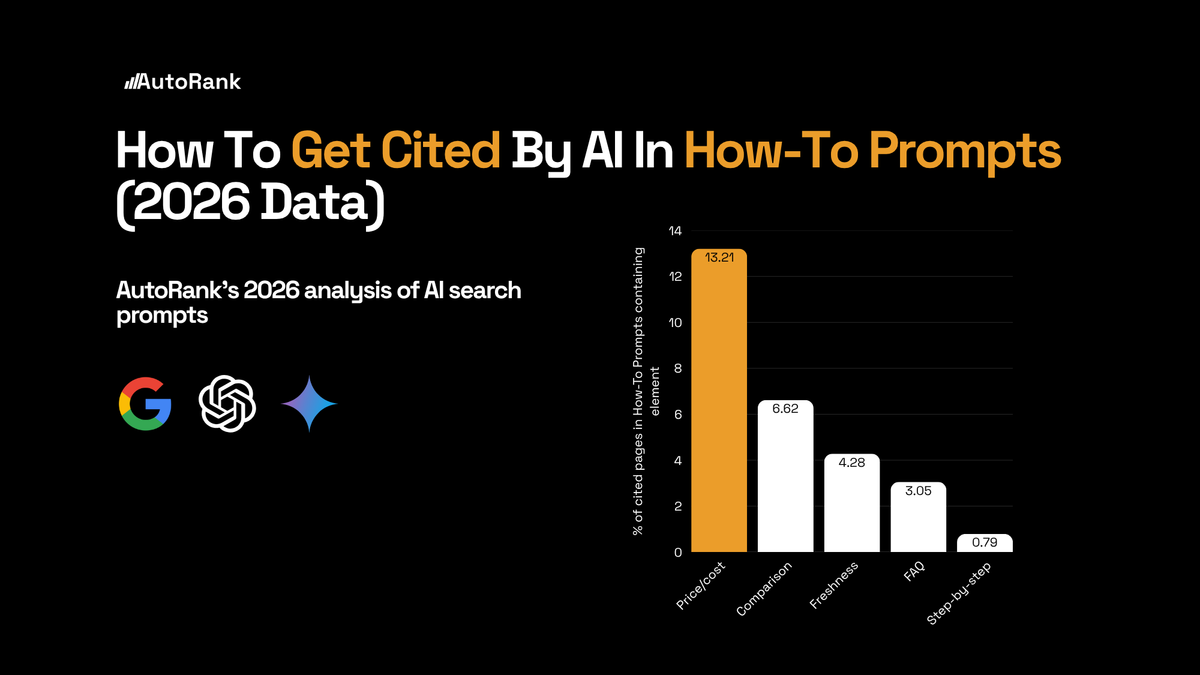
In our analysis of how-to prompts, covering a total of 22,326 citations, we looked at which elements actually appeared in the cited pages and found something unexpected:
- Price/cost: 13.21%
- Comparison: 6.62%
- Freshness: 4.28%
- FAQ: 3.05%
- Step-by-step: 0.79%
Step-by-step signals – the thing most people associate with a how-to guide – were the least common signal of all those we measured.
In practice, price/cost was 16.8 times more common than step-by-step in the cited pages. Comparison was 8.4 times more common. FAQ was 3.9 times more common.
Why Does AI Not Cite Pure Instructions?
Think about how you yourself search when you want to lose weight. You do not just want to know how – you want to know which approach suits you, what it costs to hire a coach or buy a program, what separates intermittent fasting from a low carb diet and what questions others usually have before they start.
That is exactly what AI tries to deliver. It is not looking for the purest instruction – it is looking for the page that helps the user make a well-informed decision, not just follow a recipe. High-quality content must be comprehensive enough to help users reach a decision or fulfill a goal (Google's Search Quality Evaluator Guidelines, 2024).
A pure step-by-step guide answers "how". AI wants content that also answers "which", "what does it cost" and "what should I consider".
What This Means in Practice
The cited how-to page is rarely a pure instruction. It is more often a guide combined with decision support – what it costs, what to choose between, what applies right now and answers to the most common questions before moving forward.
For anyone creating content this means that a well-written step-by-step guide is not enough. For AI to choose to cite you, your guide also needs to include pricing information, comparisons between alternatives, up-to-date information and a FAQ section that answers what people actually wonder about.
Who Wins in How-To Prompts Today?
The pages cited in AI responses for how-to prompts are those that combine clear instructions with genuine decision support. They do not just answer how something is done – they help the user understand what it costs, which alternative suits them and what they need to know before they start.
That is the combination that determines whether AI chooses to cite you when someone asks a how-to prompt in your category.
How AutoRank Helps You Appear in How-To Prompts
The first step is understanding how you appear today when your potential customers ask how-to prompts in your category. Are you being cited? For which prompts? And which competitor content is being cited instead?
In AutoRank you define the how-to prompts you want to monitor – and then the tool handles the follow-up for you automatically every day. You get a clear picture of your mention rate and share of voice compared to your competitors, and can review each individual prompt in detail. If you spot a how-to prompt where no competitor appears yet, that is your best opportunity to take position quickly before anyone else does.
With those insights as a foundation, you can go straight to AutoRank's Content Center. There you get help creating content that combines clear instructions with the decision support AI is actually looking for – so that data does not just stay as insight, but gets turned into actual visibility.
The simplest way to win how-to prompts in the AI era is to make it easy for AI to understand what you offer and why you deserve to be part of the answer. AutoRank helps you get there – step by step.
Sources:
AutoRank (2026). Internal prompt analysis of Swedish AI search prompts. https://autorank.ai/
Google. (2024). Search Quality Evaluator Guidelines. Retrieved from https://static.googleusercontent.com/media/guidelines.raterhub.com/en//searchqualityevaluatorguidelines.pdf